
Finding the Perfect Fit: An International Guide to Shoe Widths
Navigating UK, US, and Canadian Sizing Standards
Article Contents
The Science of Foot Width
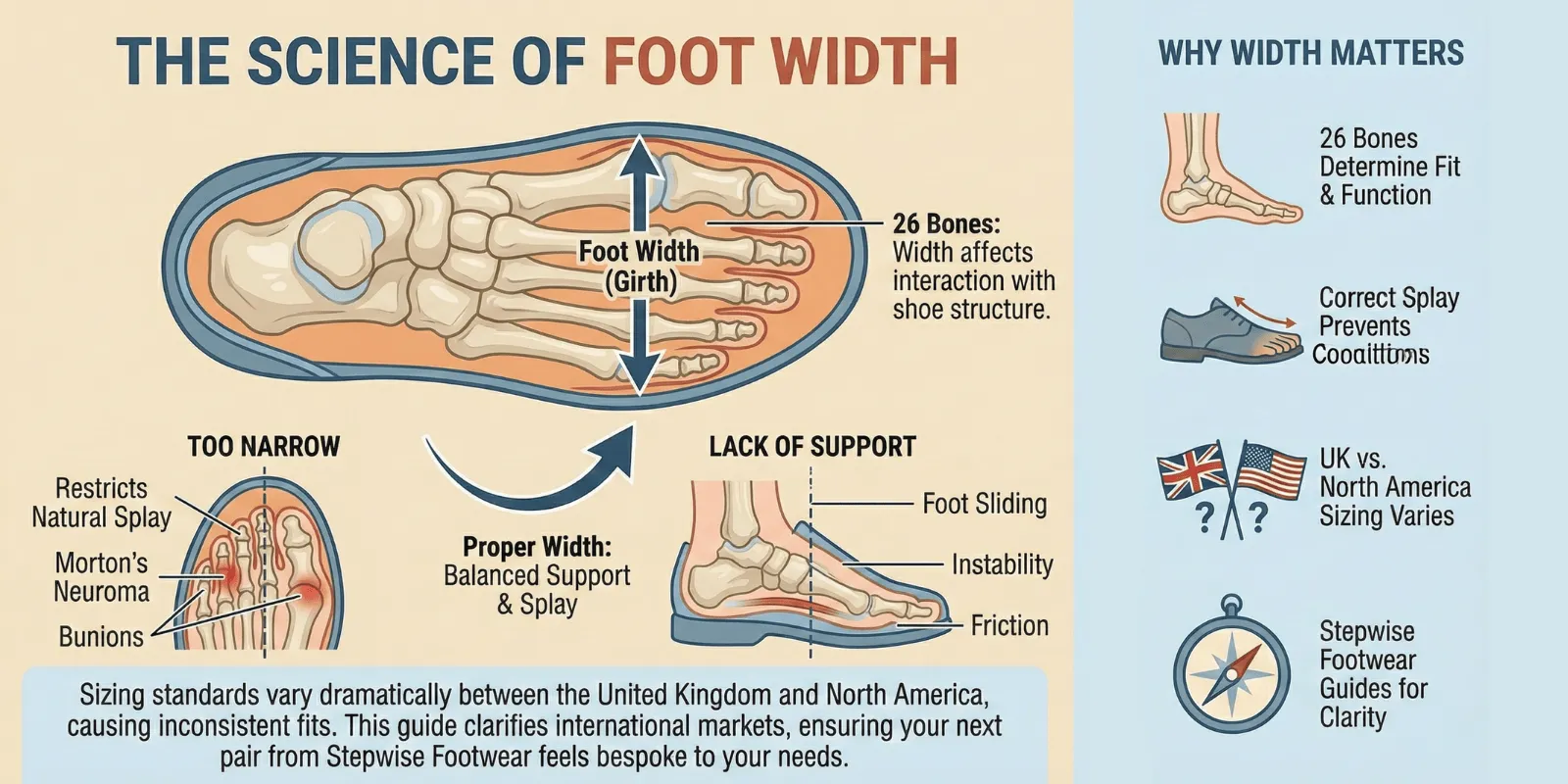 In the world of footwear, length is only half the story. The width of a shoe, often called the girth, determines how the 26 bones in your foot interact with the shoe's structure. A shoe that is too narrow restricts the natural splay of the toes, which can lead to chronic conditions such as Morton's neuroma or bunions. Conversely, a shoe that lacks proper width support allows the foot to slide, causing instability and friction.
Because sizing standards vary dramatically between the United Kingdom and North America, consumers often find themselves frustrated by inconsistent fits. This guide provides the clarity needed to navigate international markets, ensuring your next pair of shoes from Stepwise Footwear feels bespoke to your needs.
↑ Back to ContentsUK Width Lettering Explained
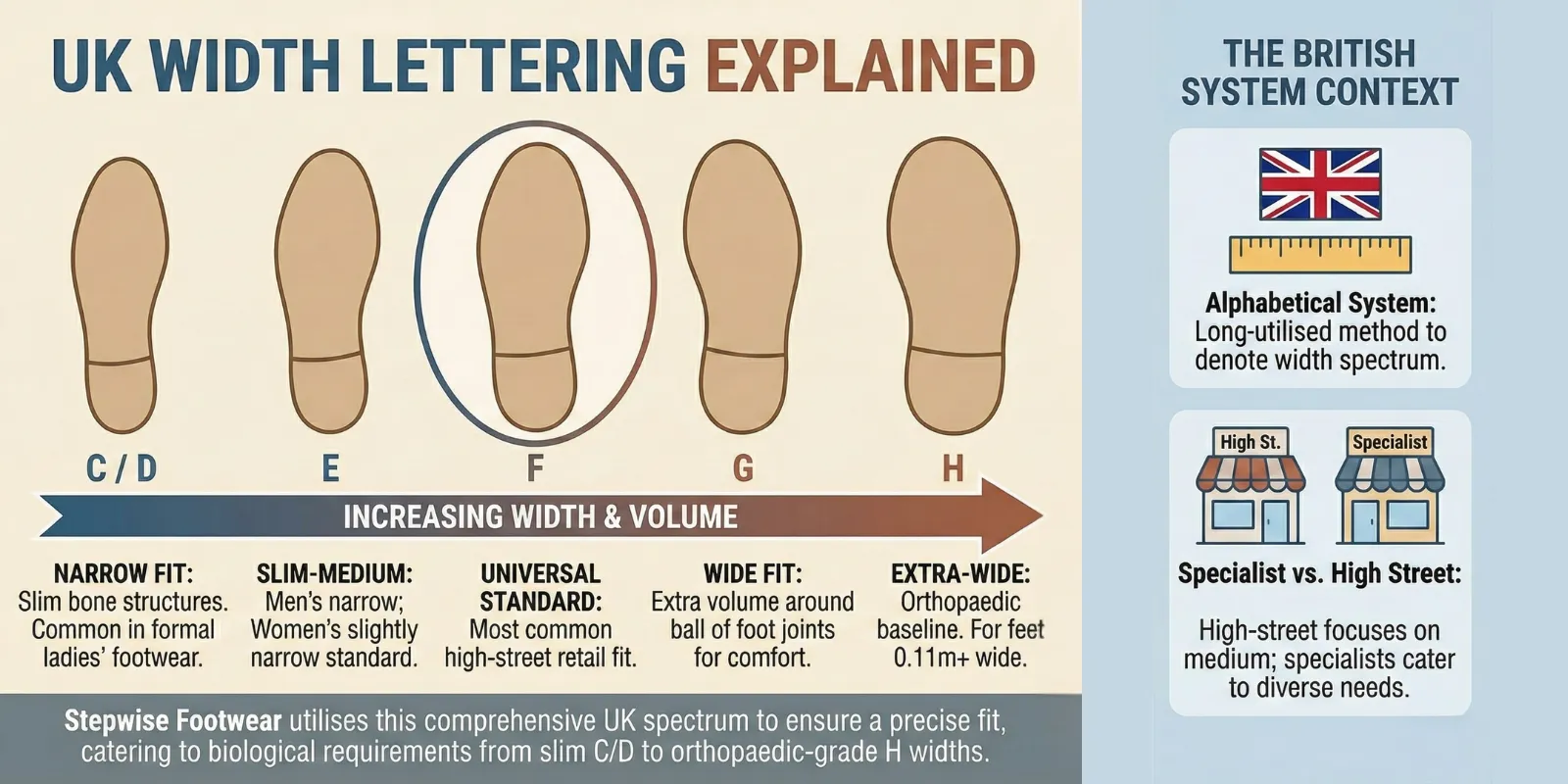 The British footwear industry has long utilised an alphabetical system to denote width. While high-street brands typically focus on a medium fit, specialist manufacturers provide a spectrum that caters to diverse biological requirements.
- C / D: Generally categorised as narrow fits, these are designed for individuals with slim bone structures, commonly found in formal ladies' footwear.
- E: This represents a slim-medium fit. For men, it is considered narrow; for women, it is a slightly narrower standard.
- F: The universal standard fit in the UK. Most shoes found in retail environments are built to this specification.
- G: A wide fit designed for comfort, allowing for extra volume around the joints of the ball of the foot.
- H: An extra-wide fit. This is the baseline for orthopaedic-grade comfort, often required for feet that measure 0.11 m [0.36 ft] or wider.
US and Canadian Width Standards
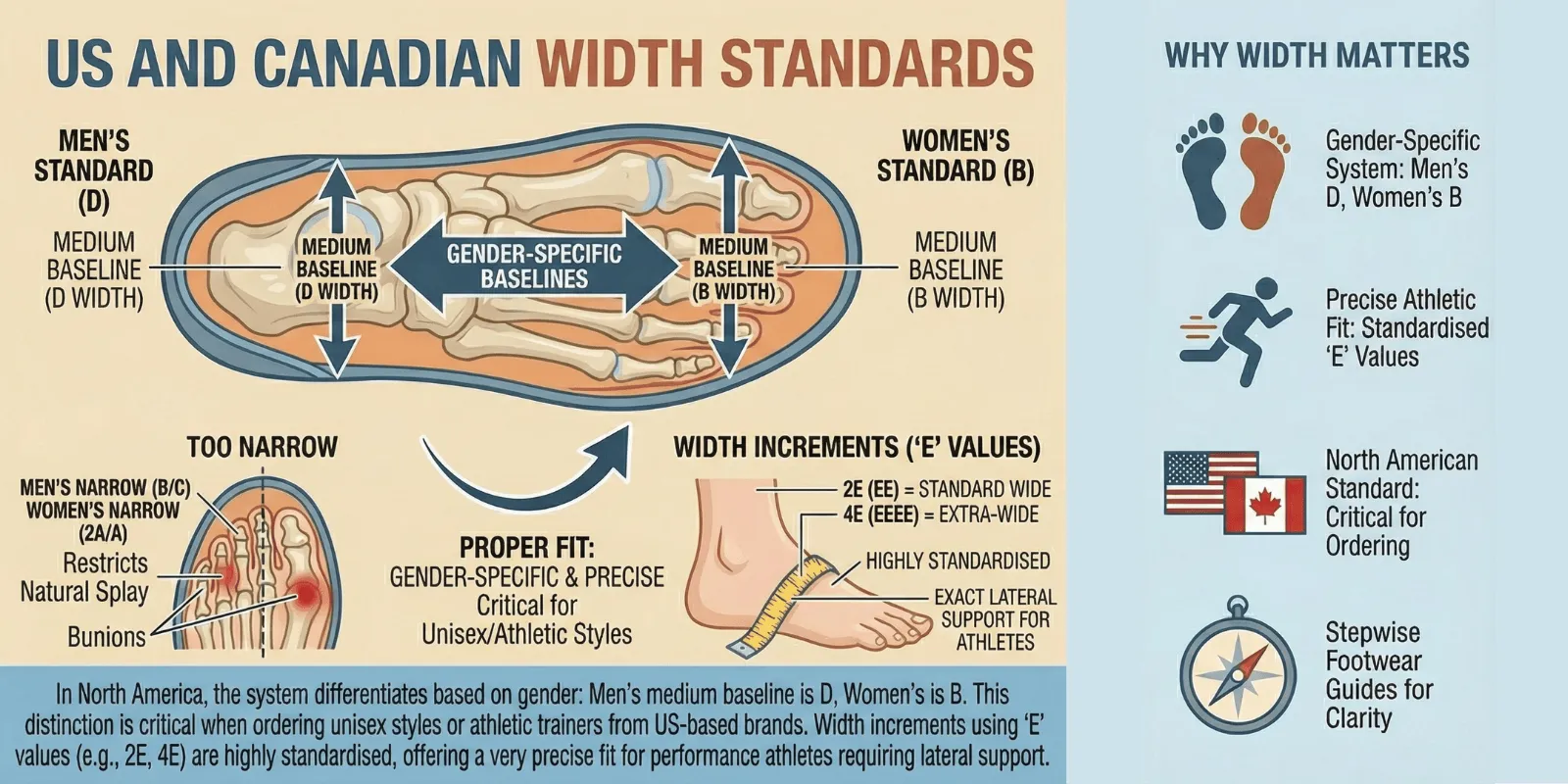 In North America, the system differentiates based on gender. For men, the medium baseline is a D width. For women, the medium baseline is a B width. This distinction is critical when ordering unisex styles or athletic trainers from US-based brands.
Width increments are often shown using 'E' values. A 2E (or EE) is a standard wide, while a 4E (or EEEE) is an extra-wide fit. Because these increments are highly standardised, they offer a very precise fit for performance athletes who require exact lateral support.
↑ Back to ContentsThe Role of the Shoe Last
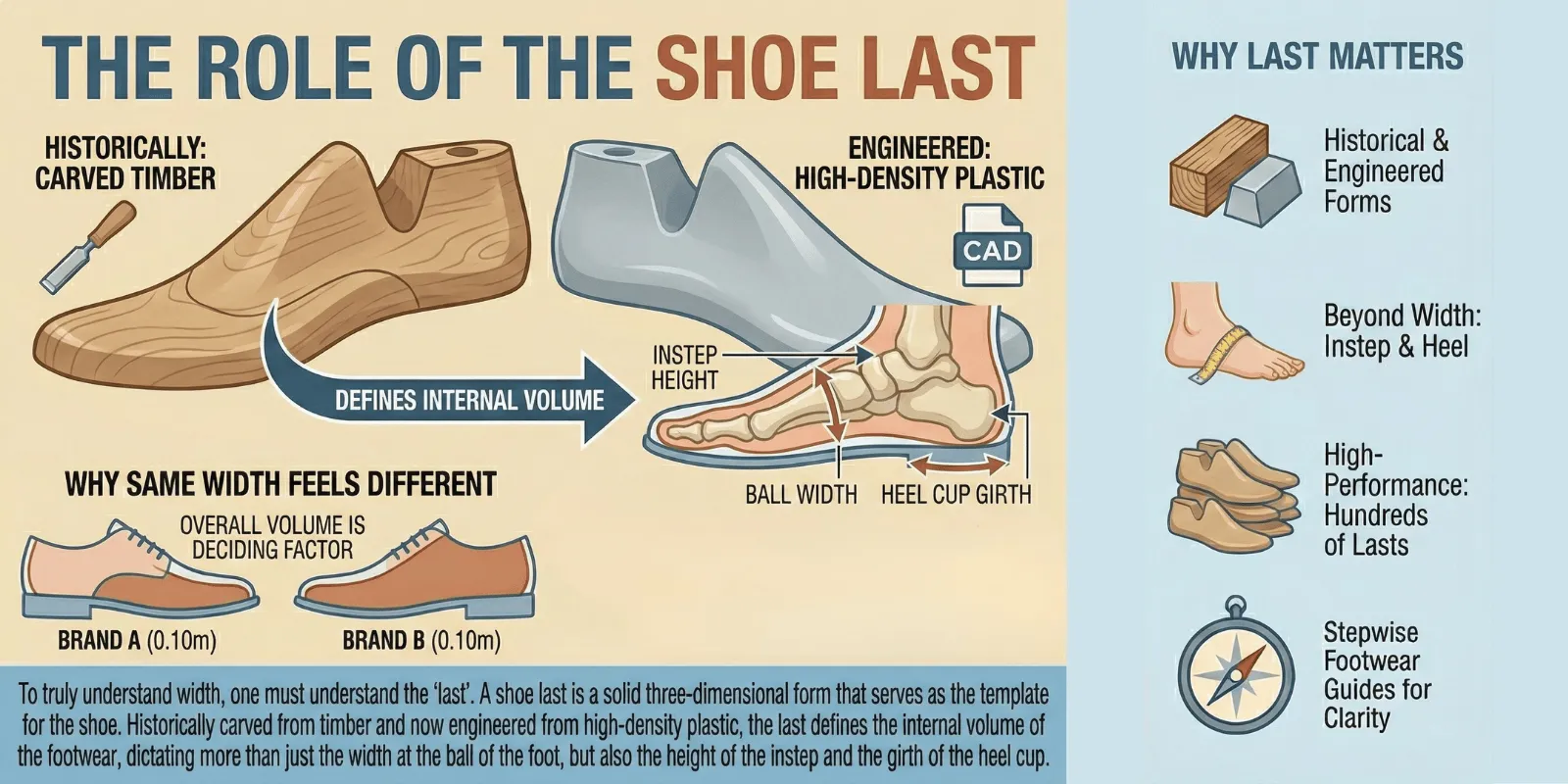 To truly understand width, one must understand the 'last'. A shoe last is a solid three-dimensional form that serves as the template for the shoe. Historically carved from timber and now engineered from high-density plastic, the last defines the internal volume of the footwear.
The last determines more than just the width at the ball of the foot. It also dictates the height of the instep and the girth of the heel cup. This is why a shoe measuring 0.10 m [0.33 ft] from one brand might feel roomier than the same measurement from another; the last's overall volume is the deciding factor.
Note that high-performance brands often use hundreds of different lasts to ensure that every width category feels structurally sound rather than just being a wider piece of leather stitched to the same sole.
↑ Back to ContentsInternational Conversion Table
Use the following table to find your equivalent width across different regional standards.
| Fit Category | UK Standard | US/Canada (Men) | US/Canada (Women) |
|---|---|---|---|
| Narrow | C / D | B / N | AA / N |
| Medium | F | D / M | B / M |
| Wide | G | E / EE | D / W |
| Extra Wide | H | EEEE (4E) | EE / WW |
Measuring Your Width at Home
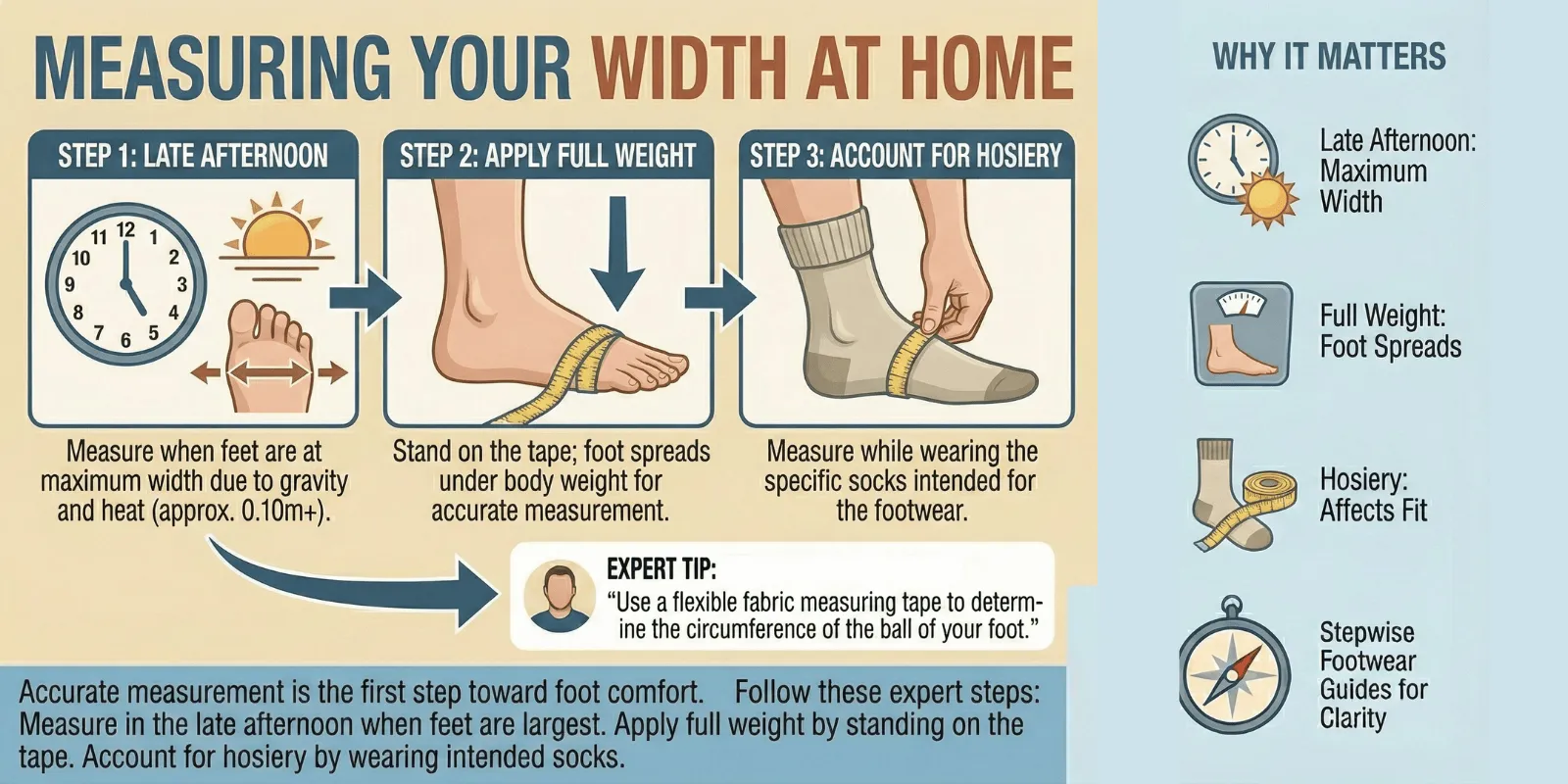 Accurate measurement is the first step toward foot comfort. It is recommended to use a flexible fabric measuring tape to determine the circumference of the ball of your foot. Follow these expert steps:
- Measure in the late afternoon. Feet naturally expand due to gravity and heat, reaching their maximum width of approximately 0.10 m [0.33 ft] or more by the end of the day.
- Apply full weight. Stand on the measuring tape rather than sitting, as the foot spreads under the pressure of your body weight.
- Account for hosiery. Measure while wearing the specific socks you intend to use with the footwear.
Width Dimensions in Metres and Feet
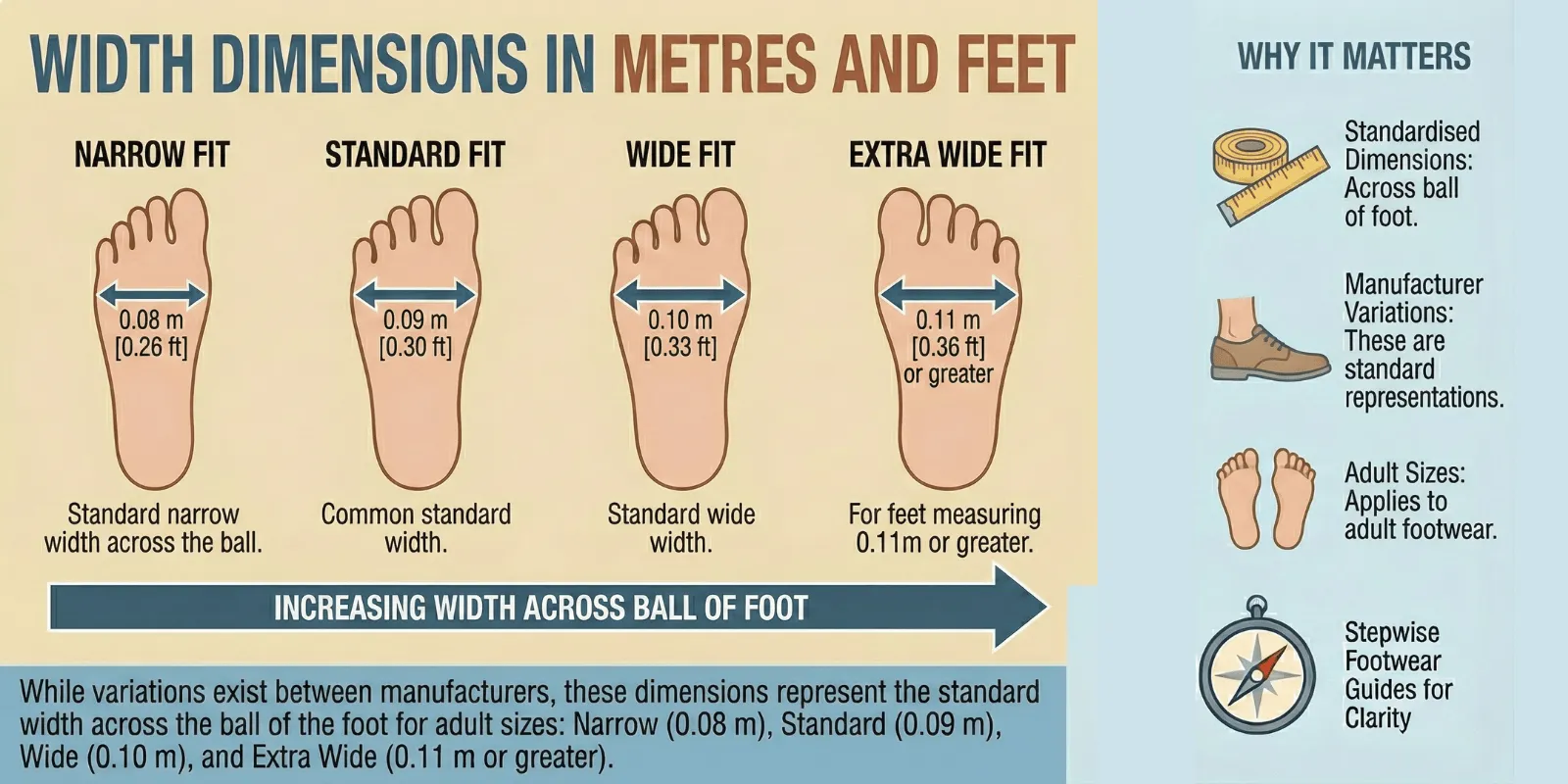 While variations exist between manufacturers, these dimensions represent the standard width across the ball of the foot for adult sizes:
- Narrow Fit: 0.08 m [0.26 ft]
- Standard Fit: 0.09 m [0.30 ft]
- Wide Fit: 0.10 m [0.33 ft]
- Extra Wide Fit: 0.11 m [0.36 ft] or greater
Frequently Asked Questions
- Is a UK 'F' fit equivalent to a US 'F' fit? No. In the UK, 'F' is the standard medium. In the US, the letter 'F' is rarely used; the equivalent medium for men is a 'D' and for women is a 'B'.
- How does the shoe last affect the feel of a wide shoe? The last determines the volume. Even if a shoe measures 0.10 m [0.33 ft] in width, a low-volume last will make the shoe feel tight across the top of the foot (the instep).
- What does '4E' mean in North American sizing? This is a specific extra-wide fit for men, common in running shoes. It equates to a UK 'H' width.
- Why do my feet feel wider in the summer? Warm weather causes the feet to retain more fluid, which can increase your width from 0.09 m [0.30 ft] to a wider 0.10 m [0.33 ft].
- Should I buy a longer shoe if I cannot find a wide fit? This is strongly advised against. Sizing up in length prevents the shoe's arch support from sitting in the correct position, leading to strain.
- Can I find shoes wider than 0.11 m [0.36 ft]? Yes, specialist orthopaedic brands produce 6E and 8E fits for medical needs, providing significantly more girth than high-street options.
- Do different materials affect width fit? Yes. Natural leather and mesh allow for some stretching (a few millimetres), while synthetic materials and patent leather will not expand.
- What is a 'B' width in a UK shop? A 'B' width in the UK is exceptionally narrow and is generally only found through bespoke or luxury specialist makers.
- What are the signs that I need a wider shoe? If you experience numbness, persistent blisters on the sides of your toes, or if your foot visibly bulges over the edge of the sole, you require a wider category.
- Are wide shoes heavier than standard shoes? Only slightly. Because a wide-fit shoe is built on a larger last with more leather and a wider outsole, it may weigh a small amount more than a narrow version.